The Black Stuff in Brita Filters Taught Me What Quality Really Means
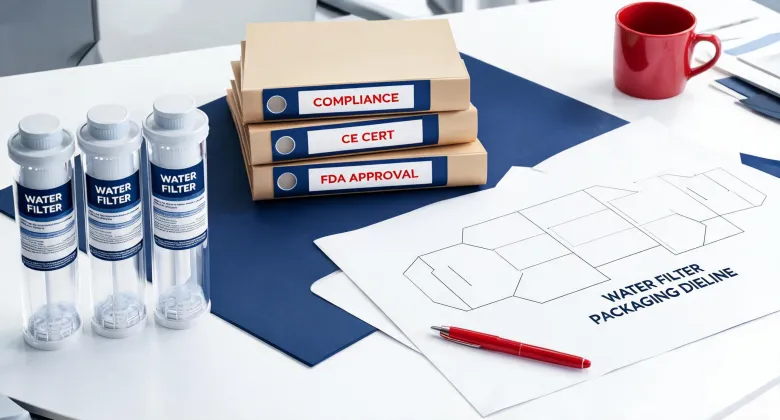
I'm a quality inspector and brand compliance manager at a consumer goods company. I review every product sample before it reaches customers—roughly 200 unique items a year. In 2024, I rejected 4.2% of first deliveries due to spec mismatches and usability concerns. Almost every rejection came down to the same issue: the product made someone stop and question it. That's the real quality standard.
I'll say it plainly: quality is not what the spec sheet says. Quality is what the customer perceives when they actually use the product. The black stuff in a Brita filter isn't just carbon. It's a brand trust test. And how a brand handles that test says more than any lab report.
The Black Stuff in Brita Water Filters Is a Perception Problem
If you've typed 'what is the black stuff in brita water filters' into a search bar, I've been there too. The answer is almost always carbon fines. Activated carbon is a loose media, and fine black particles can wash out of a new filter cartridge for the first pitcher or two. Brita's own support materials say the particles are harmless and that you should flush the filter before drinking. As of early 2025, that's still the guidance I'm aware of.
I don't doubt it. But from a quality perspective, 'harmless' is not the same as 'ready for the customer.' If a normal product setup makes someone feel unsafe, even for a minute, that's a design or communication failure. The lab tests for contaminant reduction might pass. The user experience still fails.
What I'd want to fix is the moment between 'black specks in the pitcher' and 'let me search the internet.' That moment is where trust leaks. The flush instruction should be impossible to miss—not buried in a QR code or a fold-out insert. In my audits, I don't just check whether the filter works. I check whether the first-use experience makes the customer doubt it.
Brita Water Filter Microplastics: The Problem With the Word 'Filter'
The search phrase 'brita water filter microplastics' comes up a lot in product QA discussions. It makes me bristle. A standard carbon filter is designed to reduce chlorine, taste and odor, and depending on the model, some heavy metals like lead. It is not a universal pollution-removal system. Brita's standard cartridges aren't marketed as microplastic removers, and I'm not aware of any third-party certification for that as of early 2025.
Some Brita models are certified to NSF/ANSI 42 for taste and odor and NSF/ANSI 53 for lead reduction. Those are real, valuable claims. But they're not the same as microplastic removal. That's not a knock on Brita. It's a category problem. The word 'filter' makes people expect everything gets removed. Then they learn the limitations, and they feel misled. That's an expectation gap, not necessarily a product defect.
The counterintuitive part is this: the microplastics aren't the main issue. The main issue is the mismatch between a product's name and its actual performance. If someone wants microplastic reduction, they need to look for a filter that explicitly claims that and provides test data—not assume a standard water filter jug will handle it.
I'd rather see a label that says 'reduces these five specific contaminants' in bold than a brand promise that sounds like a water purifier. Underpromise and overdeliver. That's not just a marketing slogan. It's a quality strategy.
Beyond Water: Electric Water Heaters, Refrigerators, and Remote Buttons
This won't stop at water. I apply the same lens to everything in my own house.
Take the electric water heater bath test. Filling a bathtub is one of the most honest quality checks for an electric water heater. If it can't keep up with a 40-gallon fill, you don't care about the wattage rating. You just feel a lukewarm bath. In our case, the heater's capacity was technically fine, but the recovery lag was enough to make the last part of the bath noticeably cooler. Not a failure. A perception gap.
Same with our Frigidaire 20.0 cu ft top freezer refrigerator. The unit runs, the temperature is stable, and the freezer works. But the crisper drawer track came misaligned from the factory. The spec sheet says 20.0 cu ft. The truth is that the usable space and drawer alignment matter more than the number. The drawer took me two minutes to fix, but it also cost the brand a little of my confidence. The product made me stop and question it. That's a quality defect, even if the refrigeration itself is perfect.
And then there's the Samsung remote. I lost more time than I want to admit looking up 'what does smart hub button look like on samsung remote' while staring at the remote in my hand. It's the small, flat key with a house icon inside a colored circle, just below the directional pad. On many current Samsung smart remotes, it isn't labeled 'Smart Hub.' It's just a tiny house. If someone who reviews products for a living has to search for it, the button fails the usability test. The function is fine. The discoverability isn't.
These are different products, but the pattern is the same. A product can meet every technical spec and still fail the only quality test that matters: does it make the user doubt the brand?
What I'd Tell a Skeptic
Before you tell me I'm overreacting, I know. Carbon fines are harmless. Microplastics are in tap water regardless. A misaligned drawer can be fixed. A remote button is a small thing. But I've watched enough product recalls and rejected shipments to know that small doubts compound.
The products I reject aren't usually the ones with one dramatic failure. They're the ones with lots of little moments that make a user wonder, 'Is this normal?' That question is impossible to un-ask. Once a customer doubts your quality, every other good feature matters less.
Looking back, I should have pushed for clearer setup instructions on filter products years ago. At the time, we were all focused on lab results. But lab results don't fill a pitcher. The customer's perception does the filling.
My experience is based on about 200 consumer product audits, mostly in home goods and appliances. I can't speak to commercial refrigeration or industrial water treatment—your standards may be different. And if you're reading this after 2025, double-check current Brita documentation and NSF/ANSI certifications. Product formulations and claims change.
Bottom Line: Quality Is the Brand
The black stuff in a Brita filter, the microplastics question, the electric water heater bath, the Frigidaire drawer, and the Samsung remote's smart hub button all have one thing in common. They are moments where a customer pauses and asks, 'Is this okay?'
I don't care how perfect the spec sheet is. If the user has to ask, we've already missed a quality check. The best quality investment isn't a stronger filter or a bigger refrigerator. It's eliminating the moments that make people doubt.
There's something satisfying about catching a defect before it ships. But the real satisfaction is fixing the moment before the customer ever has to wonder. That's the standard I audit against. It's the standard your brand should too.

Greta Lindholm
Greta Lindholm is a household refrigeration analyst covering French-door, side-by-side, top- and bottom-mount refrigerators, mini fridges, beverage coolers, chest freezers, and upright freezers. She applies IEC 62552 and IEC 60335-2-24 while comparing energy consumption, usable volume, pull-down time, compartment temperature stability, freezing capacity, noise, door-seal leakage, refrigerant charge, and ambient-temperature performance. Her guides help importers, distributors, private-label teams, and appliance engineers select platforms around climate class, storage mix, efficiency labels, cabinet dimensions, service access, shipping density, and warranty exposure.